The Concept Processor
Medicine is an art
Praxis EMR is based on a simple premise: Medicine is an art.
This means that no two doctors chart, practice medicine, or think the same way: every provider brings a unique and personal touch to the way a patient is treated.
However, all practitioners do have one very important thing in common: a doctor, no matter what specialty of medicine, sees certain cases more often than others.
If one were to plot a distribution frequency of case types versus case presentations, one would see the familiar bell-shaped curve emerge.
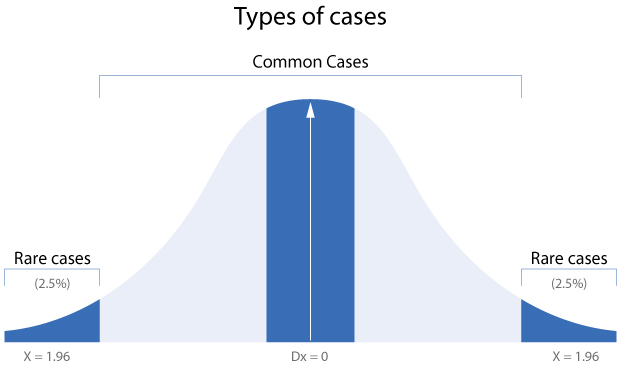
The principle of medicine as an art coupled with the bell-shaped curve forms the underpinnings of the Concept Processor, a neural network engine at the heart of Praxis EMR learns directly from the user—not only to chart instantly, but also to execute all orders and communicate with everyone instantly as well—saving hours of busywork each day.
When one begins to document an encounter with Praxis, three possibilities exist:
The present case is identical to one charted before.
Medical schools teach us that no two cases are identical. Yet in daily practice, we often write or dictate the same statements repeatedly. This happens because the mind relies on familiar language to convey similar medical concepts, and physicians tend to use the same expression to address the same situation.
Thus, when identical text is found, the case is instantly completed—not only the entire progress note, but also fully prepared and transmitted prescriptions, laboratory orders, admission orders, procedure reports, referral and consultation letters, school or work excuses, personalized intake forms and instructions sent to the patient portal, instructions for the patient and staff, and even the optimally coded superbill—all in a single, instantaneous step. The doctor is already seeing the next patient.
The present case is similar but not identical.
In this more frequent instance, Praxis presents the text of the closest case. From there, it is just a matter of editing the note to meet current conditions.
More importantly, the changes made are instantly remembered, so that the next time an encounter falls between two similar cases, editing time is reduced to half, then to a quarter, then to an eighth of what it was before. The more one charts with Praxis, the faster and smarter it gets.
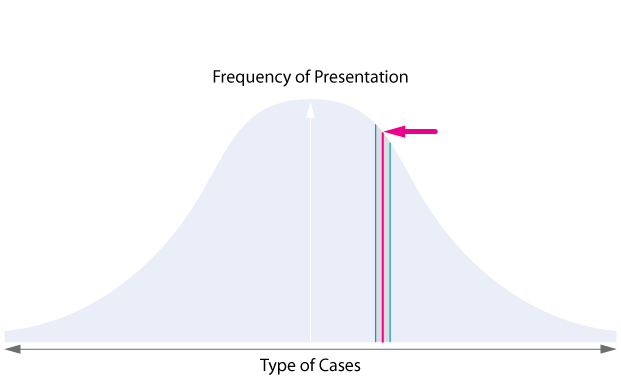
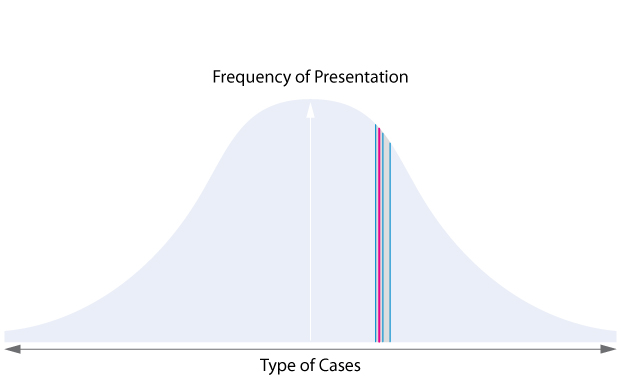
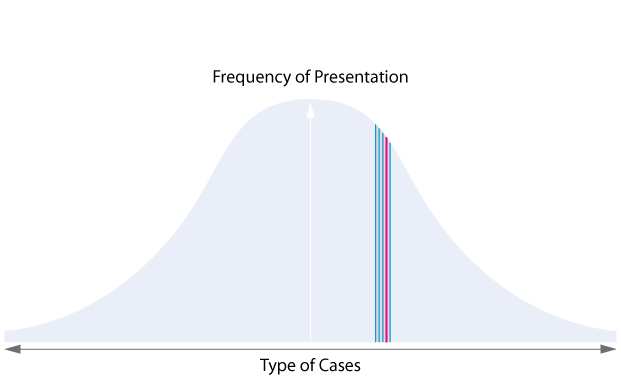
The more you use Praxis, the less editing is needed and charting becomes faster and easier. Before you know it, you are charting at the speed of your mind!
The present case is unlike anything ever charted before.
Up to this point, one might think that Praxis simply copies the entire text from a past patient note and presents it during the actual encounter. In fact, what the Concept Processor actually does is quite different. It encapsulates words, phrases, and even entire paragraphs for a particular user into concepts that may then be reused with other patients via an AI neural network.
So, rare cases are most often new combinations of not-so-rare elements that are already present in Praxis from use in other cases. The Concept Processor identifies linkages and relationships among these concepts from previous use, and because each concept has its own independent bell-shaped curve, Praxis is able to bring the right concept together with others with speed and precision whenever needed - even when charting a case that is very different from anything seen. For example, the fever instructions for a case of the common cold may be used for a case of Mediterranean Hemorrhagic Fever with few if any changes. At most, minor editing is all that is needed. The lengthy tapering dosage for a Prednisone prescription may be used for many different conditions, even rare ones.
Praxis Recalls Concepts, not Diagnoses
The Concept Processor takes into account that the same physician does not describe or treat the same diagnosis in a single templated way. In fact, one may handle the same diagnosis in many different ways, depending not only on clinical but also non-clinical conditions (such as the patient's insurance, ability to pay, social situation, and other factors determined by the practitioner's unique approach). Thus, if a different patient were to present with the same clinical and non-clinical conditions, that same practitioner would handle and chart that new case in the same way. The Concept Processor simply captures the doctor's personal approach for handling cases and then instantly links all the charting elements accordingly.
Our clients often describe the experience as fascinating—watching their own words return to them at the speed of thought. Many report that, for the first time in their professional careers, they begin to understand how they actually think through each medical case. Several describe a Eureka moment when first using the application, after which using Praxis becomes intuitive and intellectually rewarding. The physician focuses on the creative and diagnostic aspects of medicine—tasks that require true intelligence—while the computer handles the mundane details far more efficiently than any human can. All the minutiae are left to Praxis.
It gets even better: the chart becomes a powerful personal checklist, ensuring that nothing is forgotten or overlooked—that every “t” is crossed and every “i” is dotted. If a case was documented correctly in the past, it cannot be done incorrectly now. And if a past mistake is discovered and corrected, that same error will never recur. As a result, random errors progressively diminish—along with the stress and fear of forgetting something. Most importantly, the most common causes of malpractice decline dramatically.
It becomes a perfect marriage, transforming one of the most tedious tasks—charting—into a powerful medical tool that helps the physician practice better medicine with less professional stress, and dramatically faster and easier.
The Learning Curve
The greatest surprise to most of our clients is the speed at which a Concept Processor becomes useful. To understand why, you must first appreciate how we think medicine.
While the Oxford English Dictionary defines more than 400,000 words, most of college graduates are found to use less than 1500 words. Of course, not two of us use the same set of words!
But we don’t actually think in words, do we? Surely, you’ll agree that no one thinks in letters (“l,” “e,” “t,” “t,” “e,” “r,” “s”—right?). Even words themselves are merely mental abstractions—encapsulations of concepts that occur semi-automatically at the moment of expression, likely in Broca’s area of the brain. Our conscious mind operates with concepts, which we access subconsciously with extraordinary speed whenever needed. This also explains why we tend to write the same way for similar cases.
With the Concept Processor, this secondary automatic process is transferred to the computer. The bell-shaped curve effect ensures that AI learning grows geometrically, accelerating the more you use Praxis. After just a few hours of practice with imaginary patients, Praxis is ready to support your work in the clinic. And from there, everything takes off.
Once in the clinic, the physician starts by entering the simplest cases, then the more complicated ones, and finally the rest. The process is that simple.


Time that the average case takes to enter versus number of cases entered.
Obviously, the learning process gets faster and faster as more cases are seen.
But even when the charting speed reaches its plateau, the quality of charting will continue to improve indefinitely. You will always be building on your own past documentation to make the next case that much better.


Average speed of cases that may be charted per hour.
“ Your mind does not think in a template system. Before templates, before words, your mind has a concept. This concept is related to the diagnosis and then expressed in words. The heart of Praxis is a Concept Processor that links your mind to Praxis. Physicians are not all trained the same way; therefore, they have different concepts of the same diagnosis. In Praxis, this concept continues to evolve as medicine changes. ”
Dr. Robert Comeau
OB-GYN
The Concept Processor is not limited to Charting
From the discussion above, one might assume that Praxis is focused solely on instant charting—but that’s far from the case. The same AI technology that generates your clinical notes can also run your practice by learning directly from you.
For example, once you decide that a patient should return in one month for a 30-minute visit, Praxis will automatically schedule the appointment—avoiding conflicts with other patients or your time off. All the patient needs to do is confirm or adjust the time, and it’s done instantly. More importantly, the next time a different patient presents with the same condition, Praxis will immediately schedule that follow-up in the same way—one month, 30 minutes.
As we like to say: You may disagree with someone else, but it’s very hard to disagree with yourself. And in the rare case that you do, it’s either because you made a mistake in the past—which you now correct forever—or because this is a slightly different situation, which Praxis instantly learns for the future. The more you use Praxis, the less you disagree with it—until, eventually, you don’t disagree at all.
In the same way, Praxis builds sophisticated flowcharts based on your clinical patterns, which can then be adapted to similar patients. You start with the closest match, make adjustments, and Praxis learns. The right case generates the right flowchart—complete with relevant medications, vital signs, clinical parameters, and labs to follow over time.
And of course, Praxis includes intelligent agents—automated communication modules that remind your staff, your patients, other providers, and even you, of everything that needs to happen and when. All the minutiae are handled for you. Computers remember far better than we do—and they never forget.
And all of this—schedules, flowcharts, intelligent agents, individualized patient portals—requires no additional effort from you. Simply review and accept them as they appear in your progress note, and Praxis carries out your orders instantly and automatically.
Saves 2.5 Hours a Day on Useless Computer Tasks
The Concept Processor saves the average physician 2.5 hours of charting each day.
However, Concept Processing is far more than just charting. It handles every aspect of your practice faster and better.

Ambient AI. Why It’s Bad Medicine
Ambient AI also known as "AI Scribes" seems like the perfect solution for medical charting. What could be easier than doing nothing?
Experience the Future of AI-based Documentation with Praxis EMR
We invite you to join us for a live interactive demo — a one-hour session to see Praxis in action and get all your questions answered. Our team will contact you to schedule your personalized demo at your convenience.
Not Just an EHR. A Medical Tool.
Praxis EMR Benefits
Praxis is an AI-based medical tool. With every patient encounter, the Concept Processing technology inside Praxis learns from you, becoming faster and more intuitive, adapting to the way you think and practice medicine.
-
Reduce errors and stress
Filter incoming data noise (information overload), reducing errors and stress
-
Make your practice more effective
Create your own Practice Guidelines, making your practice vastly more effective
-
Integrate Your Billing
Choose seamless Integrated Billing and Revenue Options
-
Engage Your Patient Population
Experience AI Driven Patient Engagement with Praxis's Patient Portal and Patient Intake.
-
Run and Manage your own Queries
Run and manage your own powerful queries with the only prospective query engine in medicine

More Features
RAI has capabilities that no other ambient AI system can match. We've only scratched the surface.

Powerful Praxis Agent Reminder
Praxis Agents are dedicated clinical ambassadors who help you get the most from our AI-driven EHR, ensuring you maximize Praxis EMR for your practice.

Patient Self Scheduling
Transform your practice with Praxis EMR's Online Patient Self-Scheduling and harnesses AI to streamline appointment bookings.

Automated MIPS and ACO Reporting
Intelligent MIPS and ACO Reporting enhances accuracy and ensures your practice meets performance metrics effortlessly and maximizes potential incentives.

Real-Time Integrated Labs
Lab results stream directly into your charts in real time, giving you instant access to the latest information without manual searches.

AI Driven Patient Portal
Enhance patient communication and engagement through personalized, intuitive interactions tailored to individual patient needs.

Advanced Security
Implement advanced security measures to protect patient data and ensure HIPAA compliance.
Still using a Template EHR System?
Switch to Praxis EMR and start saving 2-3 hours a day.