Best AI Scribes for Physicians in 2026
(October 2026 Update)
And Why Reflective Ambient Intelligence (RAI) Changes Everything
Praxis EMR — Reflective Ambient Intelligence (RAI), Freed AI, Abridge, Suki AI, DeepScribe, Nabla, Microsoft Nuance DAX Copilot, Heidi Health, Dragon Medical One (DMO) and Augmedix.
The Complete Clinical Guide to AI Medical Scribes, Ambient AI, and Reflective AI for Modern Physicians
This guide reviews the leading AI medical scribes, ambient AI platforms, and Reflective Ambient Intelligence (RAI) systems physicians are evaluating in 2026.
Physicians evaluating AI scribes today face an important decision: choose a system that merely transcribes conversations, or choose clinical AI that preserves physician reasoning, documentation quality, and authorship.
Artificial intelligence is rapidly transforming medical documentation. Physicians across every specialty are searching for ways to reduce charting burden, improve efficiency, and spend more time with patients instead of screens.
As a result, AI scribes and ambient AI documentation tools have exploded in popularity. But physicians are beginning to discover an important reality: Not all clinical AI is the same.
Many AI scribes simply transcribe conversations. They generate notes quickly, but often require extensive editing, introduce hallucinations or omissions, fail to capture medical decision-making, and detach physicians from authorship of the medical record. This has created a growing divide in healthcare:
AI systems that merely document conversations
AI systems that actually support clinical thinking
That distinction matters. Because medicine is not transcription. Medicine is reasoning.
How We Evaluated AI Scribes and Clinical AI Platforms
To create this guide, we evaluated each platform across the factors physicians care about most in real-world practice:
- Documentation accuracy
- Editing burden
- Ability to capture medical decision-making (MDM)
- Clinical reasoning support
- Workflow efficiency
- Specialty adaptability
- Ease of implementation
- Physician authorship and medico-legal defensibility
- Integration into daily clinical workflows
Many AI scribes improve speed initially, but physicians often discover that documentation quality, editing time, and cognitive burden ultimately matter more than rapid transcription alone.
The systems below represent some of the most discussed clinical AI and AI scribe solutions currently used in healthcare.
Best AI Scribes and Clinical AI Platforms in 2026
Below is a review of the leading AI scribe and clinical AI solutions physicians are evaluating in 2026.






1. Praxis EMR — Reflective Ambient Intelligence (RAI)
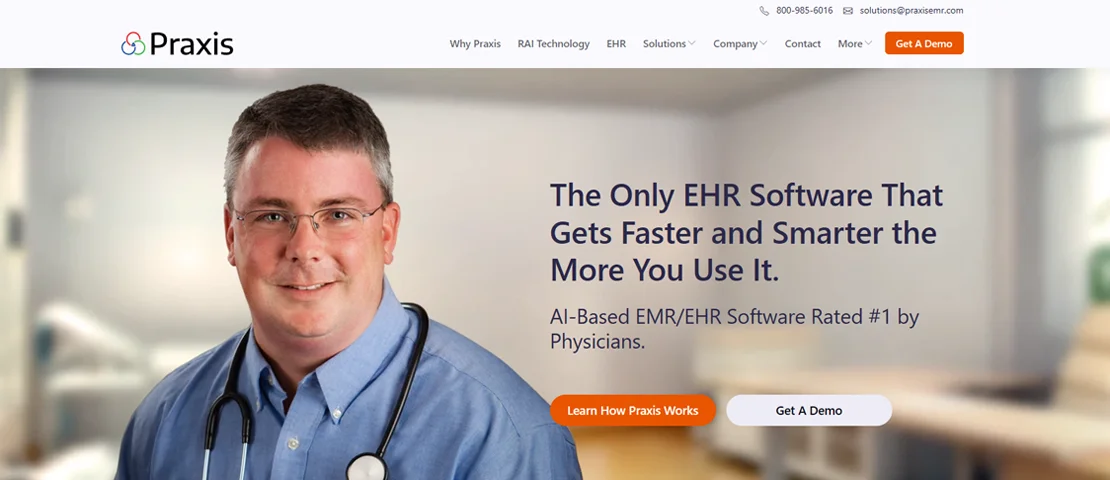
Praxis EMR introduces something fundamentally different from conventional AI scribes:
Reflective Ambient Intelligence (RAI)
Unlike traditional ambient AI systems that primarily transcribe patient conversations, RAI reflects the physician’s clinical reasoning, intent, and decision-making process in real time.
This is a major breakthrough in clinical AI.
Rather than forcing physicians to become editors of AI-generated notes, Praxis preserves physician authorship while dramatically reducing documentation burden.
Why Praxis RAI Is Different
Reflects Clinical Thinking
RAI captures not only what was said during the encounter, but what the physician meant clinically.
Preserves Medical Decision-Making
Medical necessity, assessment complexity, treatment rationale, and physician judgment remain central to the note.
Reduces Hallucinations and Errors
Traditional AI scribes can introduce incorrect details or omit critical findings. RAI minimizes these problems by aligning documentation with physician intent.
Minimal Editing Required
Many physicians discover that AI scribes create additional work because notes must be heavily reviewed and corrected. Praxis RAI dramatically reduces editing burden.
Learns From the Physician
Praxis is template-free and adaptive. The system continuously learns from physician workflows and evolves over time.
Fully Integrated AI EHR
Praxis is not merely an AI scribe layered onto an old EHR. It is a fully integrated AI-driven clinical platform.
Praxis v9 Innovations
Praxis v9 introduces:
- Reflective Ambient Intelligence (RAI)
- AI-driven patient intake
- Intelligent patient portal
- Patient self-scheduling
- A modern AI-driven user interface
- Template-free adaptive workflows
- Integrated communication tools
The result is faster charting, improved documentation quality, and better physician-patient interaction.
Best Fit
- Primary care
- Family medicine
- Internal medicine
- Specialty practices
- Concierge and DPC
- Multi-specialty groups
- Physicians seeking long-term clinical AI solutions
Bottom Line
Praxis RAI is not simply another AI scribe.
It represents the next evolution of clinical AI.
AI scribes document conversations.
Reflective Ambient Intelligence documents clinical reasoning.




How Praxis EMR Works
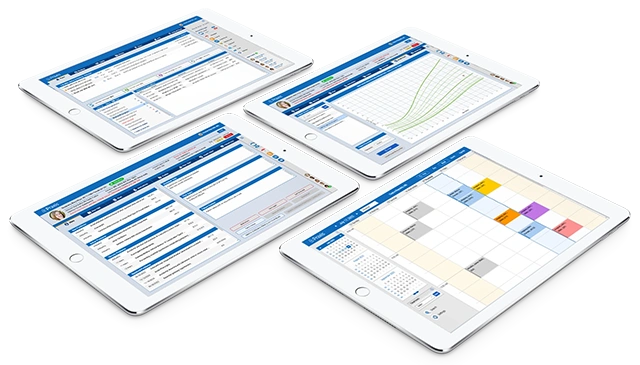
Praxis EMR is dramatically different. It thinks like you do. The Artificial Intelligence (AI) inside Praxis gets faster and easier as you use it. Praxis is not just an EHR system; it's a medical tool.

2. Freed AI
Freed AI has become one of the more recognizable AI scribe platforms among independent physicians and outpatient clinicians seeking a lightweight ambient AI workflow.
The platform emphasizes simplicity, ease of onboarding, and rapid deployment without major workflow disruption.
For many physicians new to AI documentation, this low-friction approach can feel appealing.
Strengths
- Simple interface and fast implementation
- Minimal setup and onboarding time
- Efficient for straightforward outpatient encounters
- Popular among solo and small practices
- Lower learning curve than many enterprise platforms
Potential Limitations
Freed primarily functions as a transcription-oriented ambient AI system. As a result, physicians still remain responsible for reviewing and correcting generated notes.
In more nuanced or medically complex visits, clinical reasoning, assessment hierarchy, or treatment rationale may not always be fully reflected in the documentation.
Some physicians also report that editing burden increases over time as encounter complexity rises.
Best Fit
- Solo practices
- Primary care
- Lower-complexity outpatient workflows
- Physicians seeking introductory ambient AI tools

3. Abridge
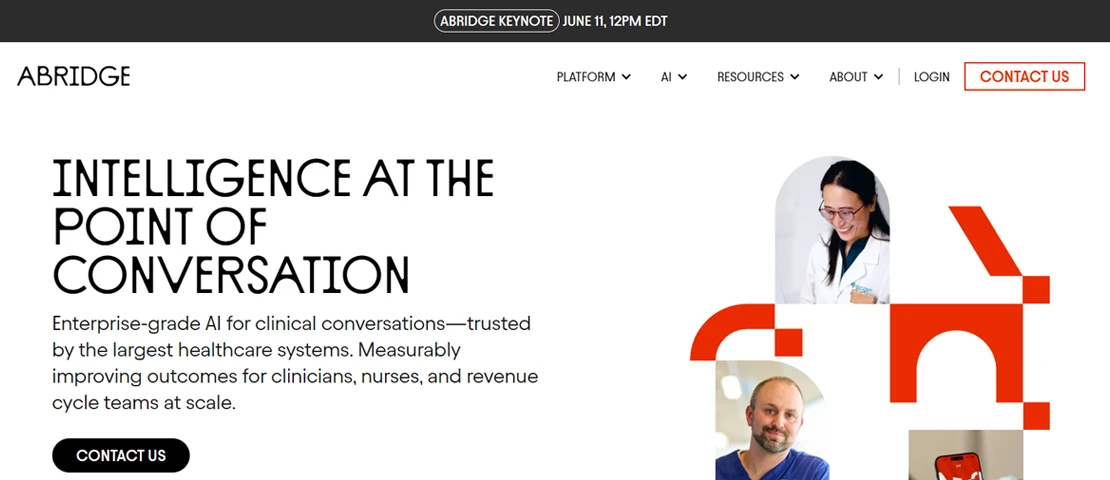
Abridge has emerged as one of the most visible ambient AI companies in healthcare and is increasingly associated with enterprise health system deployments.
The platform focuses heavily on ambient listening, conversation summarization, and integration into large healthcare environments.
Strengths
- Strong enterprise integration strategy
- Significant visibility among health systems
- Automated encounter summaries
- Designed to reduce physician typing during visits
- Growing adoption within larger organizations
Potential Limitations
Like many ambient AI systems, Abridge remains fundamentally dependent on conversation capture and transcription workflows.
Physicians may still need to carefully review generated notes for omissions, inaccuracies, incomplete medical decision-making, or documentation that does not fully reflect clinical nuance.
In highly specialized or diagnostically complex encounters, physicians often remain deeply involved in post-visit editing and correction.
Best Fit
- Large health systems
- Enterprise organizations
- Multi-provider deployments
- Organizations prioritizing ambient transcription workflows
4. Suki AI
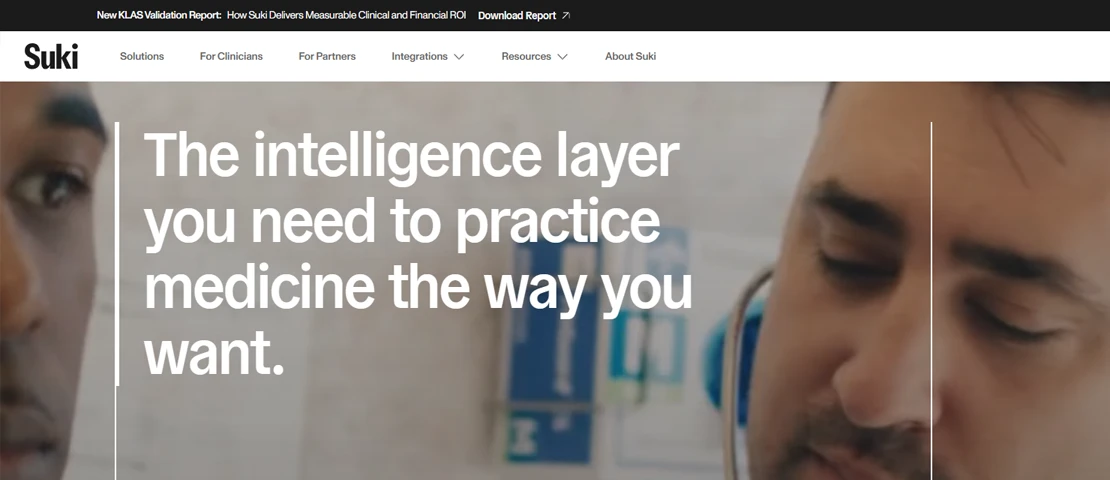
Suki combines ambient AI documentation with voice-command functionality intended to streamline physician workflows.
Many physicians appreciate the ability to interact with the system using natural speech commands while navigating charting tasks.
Strengths
- Voice navigation functionality
- Multi-specialty workflow support
- EHR command integration
- Reduced manual navigation for some tasks
- Strong brand recognition in clinical AI
Potential Limitations
Although Suki improves workflow interaction, it still relies heavily on ambient AI transcription principles.
Physicians remain responsible for reviewing generated content for clinical completeness, documentation accuracy, and appropriate medical decision-making.
As with many AI scribes, efficiency gains may decrease if extensive post-encounter editing becomes necessary.
Best Fit
- Multi-specialty outpatient practices
- Physicians preferring voice-first interaction
- Organizations exploring ambient AI adoption
5. DeepScribe
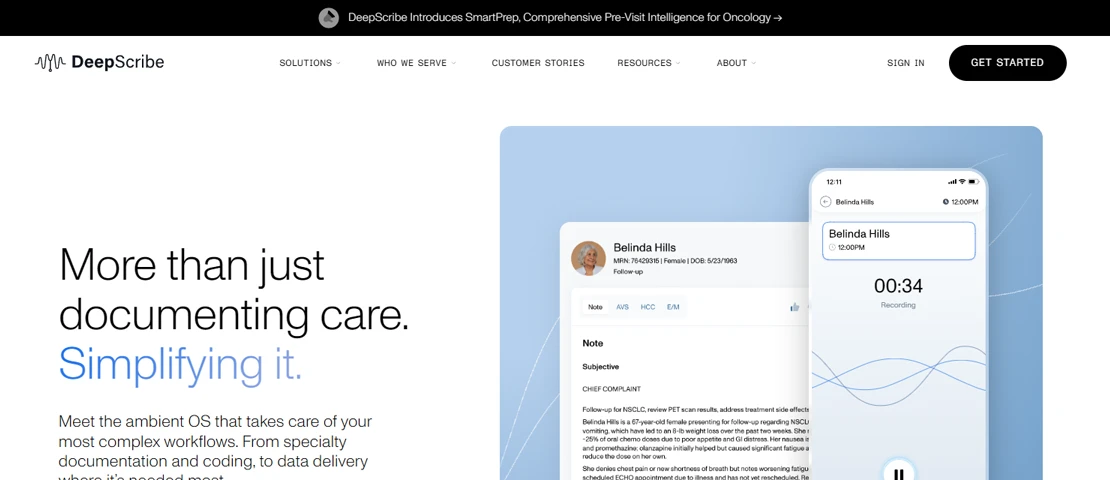
DeepScribe focuses heavily on specialty documentation workflows and has gained traction among practices seeking more tailored ambient AI note generation.
The platform attempts to adapt documentation to specialty-specific encounter styles and terminology.
Strengths
- Specialty-oriented workflows
- Detailed encounter documentation
- Structured clinical note generation
- Strong focus on physician workflow adaptation
Potential Limitations
Despite specialty optimization, DeepScribe still fundamentally relies on ambient transcription and generated summaries.
Physicians must continue reviewing documentation for omissions, hallucinations, and incomplete reasoning capture.
In more complex longitudinal care environments, preserving physician intent and nuanced clinical judgment can remain challenging.
Best Fit
- Specialty clinics
- Physicians with repetitive specialty workflows
- Outpatient specialty practices
6. Nabla
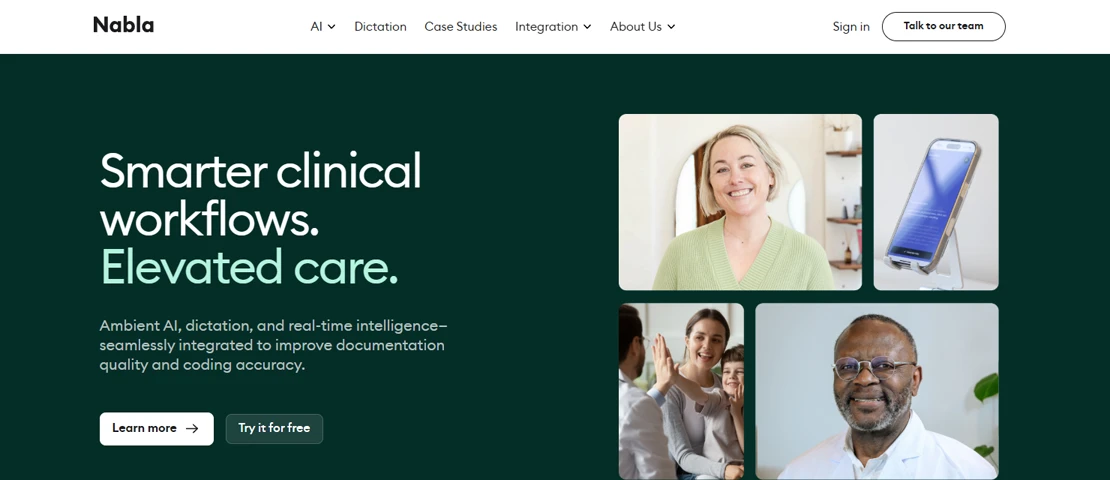
Nabla has attracted attention for its polished user experience and mobile-friendly workflow design.
The platform emphasizes speed, usability, and rapid note generation across modern clinical environments.
Strengths
- Clean modern design
- Strong mobile experience
- Fast note generation
- Streamlined interface
- Efficient outpatient workflows
Potential Limitations
Nabla remains primarily focused on improving documentation speed through ambient AI transcription.
Like many AI scribe tools, physicians may still spend considerable time reviewing, correcting, and refining generated documentation to ensure clinical accuracy and appropriate medical necessity support.
Best Fit
- Mobile-focused physicians
- Modern outpatient clinics
- Fast-paced ambulatory environments

7. Microsoft Nuance DAX Copilot
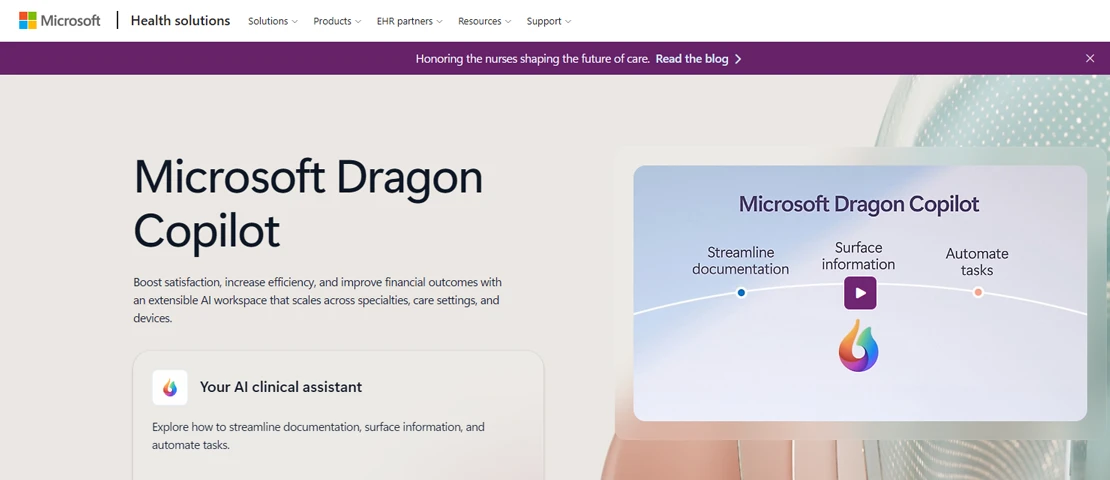
Microsoft’s Nuance DAX Copilot leverages deep generative AI and Nuance’s legacy voice footprint to serve large-scale healthcare systems. Operating seamlessly through mobile platforms (like Epic Haiku) and desktop companions, it is built to handle the rigorous security and infrastructural demands of massive hospital groups.
Strengths
- Deep, native integration with Epic, Cerner, and Meditech.
- "Beyond the note" outputs, including automated order suggestions directly within Epic, referral letters, and after-visit summaries.
- Backed by Microsoft’s enterprise-grade compliance, security architecture, and robust 24/7 IT support.
- Structured evidence mapping that allows clinicians to verify clinical facts from the recorded conversation.
Potential Limitations
- High Enterprise Overhead: The deployment, configuration, and IT analyst support required make it virtually inaccessible or impractical for small or independent practices.
- High Cost Barrier: With premium enterprise pricing typically ranging from $3,000 to over $5,000 per user annually, it carries one of the highest financial commitments on the market.
- The Transcription Default: Despite its deep EHR features, DAX Copilot relies heavily on ambient conversation capture. If a physician’s underlying clinical intent isn't explicitly spoken aloud, the initial draft will require manual intervention to flesh out complex Medical Decision-Making (MDM).
Best Fit
- Large hospital systems, academic medical centers, and enterprise organizations deeply embedded in Epic or Cerner infrastructure.
8. Heidi Health
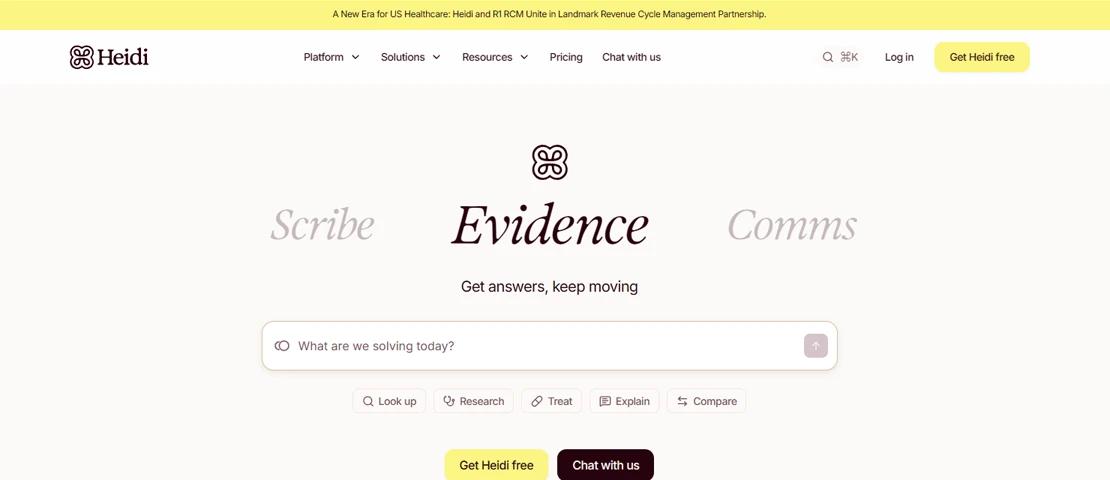
Heidi Health has quickly risen in popularity as a highly adaptable "AI Care Partner." It distinguishes itself by moving past rigid, one-size-fits-all note templates, allowing clinicians to heavily customize how data is processed, styled, and translated into revenue-ready documentation.
Strengths
- Exceptional Personalization: Highly flexible templating that allows clinicians to dictate formatting, language style, and specific section rules.
- Heidi Remote: Offers a lightweight, 21-gram wearable hardware microphone that operates fully offline with on-device encryption—ideal for noisy emergency departments or rapid ward rounds.
- Global Compliance & Language Support: Built to comply with HIPAA, GDPR, NHS, and APP standards, making it highly effective for multilingual clinics.
- Affordable Scaling: Highly accessible entry pricing (around $99/month) with zero-friction onboarding for individual clinicians.
Potential Limitations
- Platform Stability: Rapid feature deployments have occasionally led to mobile app performance regressions, requiring clinicians to rely more heavily on its desktop interface.
- Review Reliance: Because it processes a vast array of custom styles, the onus remains heavily on the physician to review the output to ensure nuances aren't lost in translation when switching between vastly different templates.
Best Fit
- Primary care providers, fast-paced ambulatory environments, and clinicians who want granular control over their note formats without enterprise IT intervention.

9. Dragon Medical One (DMO)
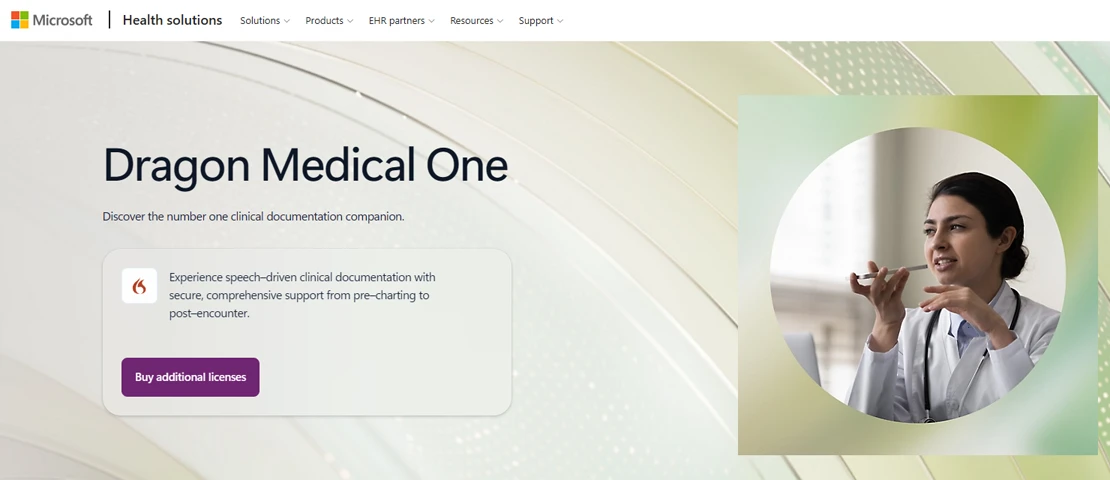
While ambient tools record the room, Dragon Medical One (DMO)—also under the Microsoft/Nuance umbrella—remains the gold standard for traditional, front-end speech recognition. Rather than summarizing a multi-party conversation, DMO is built to transcribe a physician’s direct, structured dictation with unmatched precision.
Strengths
- Flawless Medical Accuracy: Decades of optimization mean its speech-to-text models capture complex pathology, specialized terminology, and rare drug names instantly.
- Voice Macro Automations: Allows clinicians to build extensive step-by-step voice commands and macros to navigate the EHR, insert blocks of text, and sign off charts hands-free.
- Universal Compatibility: Functions as a virtual keyboard overlay, meaning it works natively inside virtually any EHR or Windows-based application without custom API integrations.
Potential Limitations
- Cognitive Load: Unlike ambient AI, DMO does not synthesize conversation. The physician must still mentally formulate the entire note and dictate it out loud, doing little to reduce the post-visit cognitive burden.
- Screen Tethering: Clinicians must actively dictate into a device or desktop microphone, keeping them anchored to a screen rather than fully engaging eye-to-eye with the patient.
Best Fit
- Specialists requiring extreme technical accuracy (e.g., Radiology, Pathology, Surgery) and clinicians who prefer absolute control over dictating their own structured notes.
10. Augmedix
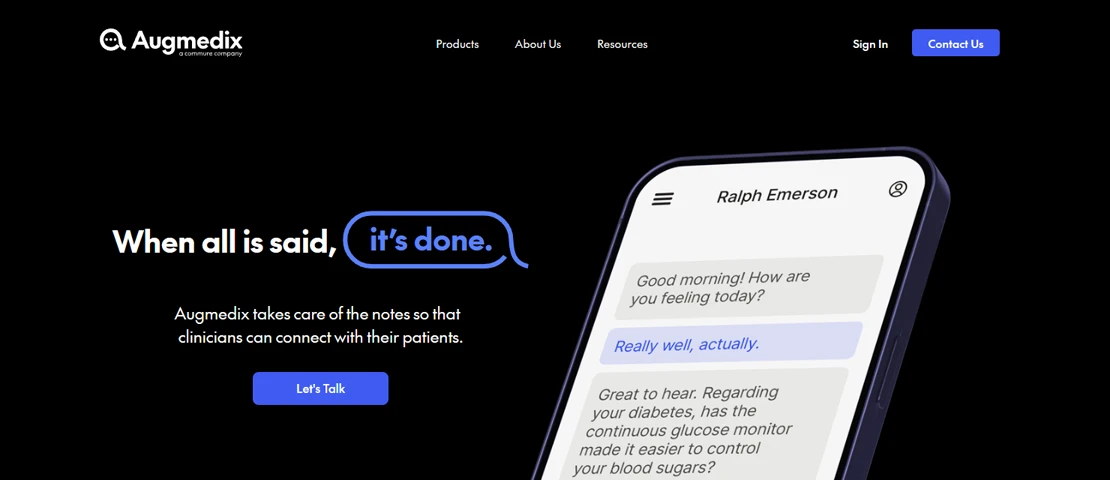
Augmedix has evolved from its early days of remote human scribes into a sophisticated, AI-driven ambient documentation platform. It focuses heavily on structured data extraction, turning ambient clinical conversations into discrete, searchable EHR data points while building comprehensive SOAP notes.
Strengths
- EHR Field Auto-Population: Uses advanced Natural Language Processing (NLP) to push structured data directly into discrete EHR fields, rather than just dumping free text into a note block.
- Ambient Discrimination: Strong multi-modal listening tech that easily distinguishes between ambient noise, patient descriptions, and physician commands.
- Custom Shortcuts: Seamlessly integrates physician-specific macros, templates, and shortcuts to accelerate note finalization.
Potential Limitations
- Integration Friction: Ensuring that discrete fields map correctly across varied, older EHR setups can occasionally require custom configuration and troubleshooting.
- Editing Tail: For highly longitudinal or structurally complex care plans, the generated summaries can lean toward generalized templates, requiring physicians to manually inject personalized clinical rationale.
Best Fit
- Outpatient practices and groups looking to turn ambient clinical encounters into highly structured, searchable EHR data.
Updated: September 29, 2026
Summary of Top AI Scribe Choices (2026)
Choosing the best AI scribe or clinical AI platform depends heavily on physician workflow, specialty complexity, documentation style, and long-term goals. Many physicians initially prioritize speed and convenience. However, over time, documentation quality, editing burden, medical necessity support, and preservation of clinical reasoning become the true metrics of success.
Comparisons
AI Scribe vs. Reflective Ambient Intelligence (RAI)
The table below highlights the difference between conventional ambient AI systems and Praxis Reflective AI™, helping physicians understand why Praxis is the safer and more intelligent EHR choice.
Audio transcription & conversational summarization.
Enterprise ambient capture & EHR order integration.
Fast, lightweight note generation from spoken words.
Enterprise-wide EHR scaling and multi-party conversations.
Variable; often increases with encounter complexity.
Moderate; requires verification of generated facts.
Independent clinics & solo ambulatory practices.
Large, Epic-integrated health systems.
| Feature / Capability | Conventional AI Scribes (Freed, Abridge, Nabla, etc.) |
Microsoft Nuance DAX Copilot |
Praxis EMR with Reflective AI (RAI) |
|---|---|---|---|
| Primary Mechanism | Audio transcription & conversational summarization. | Enterprise ambient capture & EHR order integration. | Real-time reflection of physician reasoning & intent. |
| Workflow Focus | Fast, lightweight note generation from spoken words. | Enterprise-wide EHR scaling and multi-party conversations. | Template-free, adaptive systems that learn clinical judgment. |
| Editing Burden | Variable; often increases with encounter complexity. | Moderate; requires verification of generated facts. | Minimal; notes naturally align with physician authorship. |
| Ideal Setting | Independent clinics & solo ambulatory practices. | Large, Epic-integrated health systems. | Independent practices & groups prioritizing clinical reasoning. |
While traditional ambient AI scribes have drastically reduced the mechanical burden of typing, they fundamentally leave the physician in the role of an editor—constantly reviewing transcripts for hallucinations or missing medical context. The arrival of Reflective Ambient Intelligence (RAI) shifts the paradigm entirely: it documents the thinking behind the medicine, ensuring that physician authorship, medical necessity, and clinical reasoning remain completely intact.
Schedule a Live Demo
- Watch how Praxis understands your clinical thinking
- Experience real-time documentation without templates
- See how Reflective AI eliminates hours of charting
Join a one-hour interactive session to see Praxis in action and get your questions answered.
Still using a Template EHR System?
Switch to Praxis EMR and start saving 2-3 hours a day.