
Steven McKenzie, M.D.
Family Practice

"Praxis has improved the quality of medicine I practice while respecting the way I practice," ... "It keeps my practice running more efficiently every day. I estimate small practices will make hundreds of thousands of dollars more if they use Praxis."
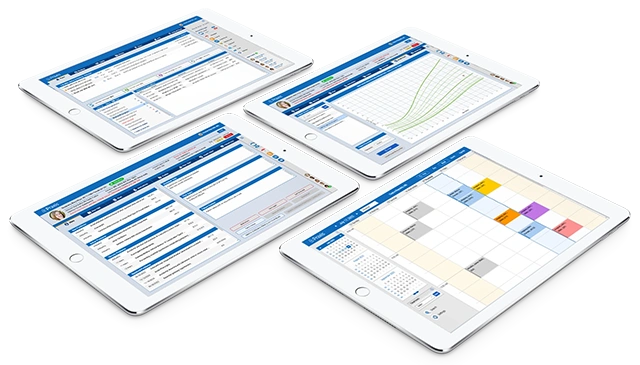
The best EHR for family practice is one that supports efficient clinical documentation, family and longitudinal care, physician workflow, patient communication, interoperability, and practice management. The right choice depends on the practice's size, specialty needs, workflow, budget, and documentation preferences. Family physicians should compare EHR systems based on usability, clinical documentation, workflow efficiency, AI capabilities, customization, interoperability, patient engagement, reporting, implementation, and total cost of ownership.
Praxis EMR is designed specifically to support family and primary care physicians with template-free charting and Concept Processing® technology that learns from each physician's documentation style and clinical workflow.

This page is intended for family medicine physicians, primary care physicians, independent physicians, private practices, small and mid-sized medical practices, and practice administrators evaluating EHR and EMR software. It focuses on the clinical and operational needs of family practice, including longitudinal patient care, preventive care, chronic-condition management, documentation, communication, reporting, and workflow efficiency.
Page focus: Family Practice EHR and EMR software evaluation.
Content context: physician workflow, clinical documentation, AI, usability, interoperability, patient engagement, and practice efficiency.

Family Medicine or Family Practice is the backbone of our nation's healthcare system, and is one of the few points of Physician contact for patients with all medical concerns covering, annual checkups, health maintenance, immunizations, health risk assessments, and treatment of common chronic conditions. Family Medicine Physicians see the nation's widest range of cases and must often coordinate longitudinal multidisciplinary care plans for entire families for decades.

Praxis EMR's focus on medical quality and usability consistently earns it number one rankings in physician user satisfaction polls, including #1 in Overall User Satisfaction, Ease of Use, Enjoyment, Medical Quality, Training & Support, Health Maintenance, Disease Management and the AAFP EHR User Satisfaction Survey.
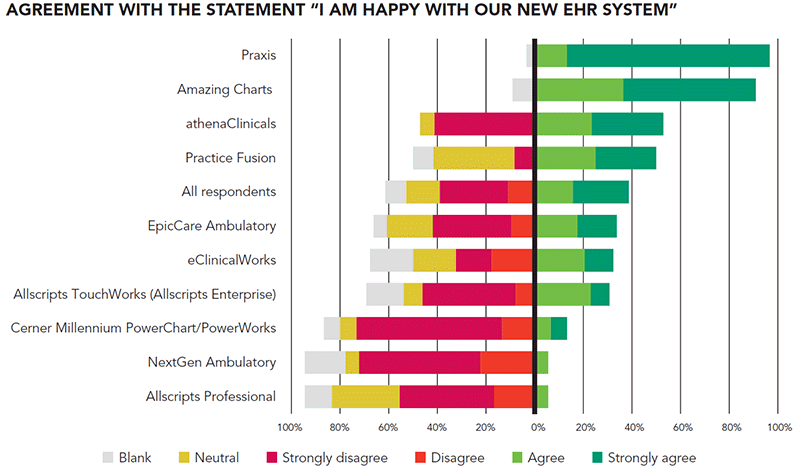
Taken from AAFP EHR User Satisfaction Survey, "Physicians Who have Switched EHRs".
Praxis is rated the Top EHR among practicing Family Medicine Physicians who have changed EHR systems In fact, AAFP physicians and providers who have switched to Praxis from another EHR "strongly agree" that they are “happy with our new EHR system".

The top EHR systems for Family Practice must be fast, easy to use, intuitive, and offer powerful practice advisories and guidelines for customized health maintenance and wellness plans for the entire family. A Family Practice EHR must also have communication features that create efficiencies allowing physicians to communicate with their patients and other healthcare workers. The top EHR systems for Family Practice must also enable reporting features that facilitate communication between physicians and patients and distribute clinical information across all channels of healthcare.
Family Practice

Family Practice

Family Practice, FAAFP

OB/GYN

Praxis is among the top EHR systems for Family Practice Medicine because it utilizes an AI-Driven template-free technology called Concept Processing that self learns from each physician user. Concept processing is a technology that uses an artificial intelligence engine to provide flexible user interfaces. This technology is used in electronic medical record (EMR) software, as an alternative to the more rigid template-based technology. As the physician practices with Praxis, the system becomes faster, smarter, and improves clinical care and patient outcomes.
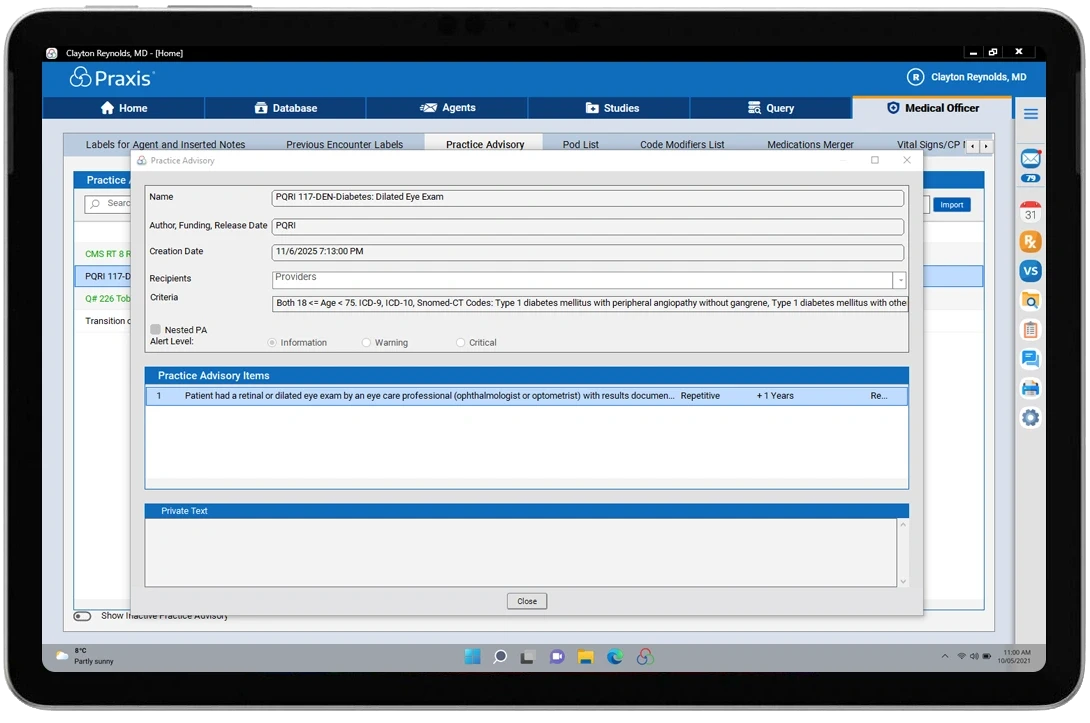
As a template-free EHR, Praxis allows family and primary care physicians to practice medicine in their own style, rather than forcing them to follow rigid, structured and difficult to use templates. As such, the Physician's clinical approach is consistently refined by Praxis to eliminate medical errors and to help physicians practice progressively higher quality medicine. Praxis levels the cost-benefit ratio so that practicing physicians don't have to spend hours charting each day. Praxis eliminates human errors in documentation so that family medicine physicians have more patient interaction without the medical errors in their charts. Praxis is the top ranked EHR system for Family Medicine and is customizable to all clinical situations, e.g., office and clinical workflow, increasing productivity to every aspect of the Family Practice.
“ Praxis means better care for the patients. ”

“ It makes my patient visits faster and helps reduce my liability. ”

“ Praxis allows you to practice medicine the way you want to practice it. ”


Internal Medicine
Praxis not only allows us to practice individually, but allows us to communicate with one other. We learn how each one of us manages patients and sees the system.
Dr. Stephen Hsieh
Internal Medicine
What is an EHR for family practice?
An EHR for family practice is electronic health record software designed to support the broad and longitudinal care provided by family physicians, including preventive care, health maintenance, chronic-condition management, clinical documentation, patient communication, and coordination of care.
What makes a family practice EHR different?
Family practice requires an EHR to support a wide range of conditions and patient needs over time. Important capabilities include flexible documentation, efficient chart review, preventive and chronic-care workflows, communication, reporting, interoperability, and tools that can adapt to the physician's workflow.
Is AI useful in a family practice EHR?
AI can support family practice by reducing documentation burden, assisting with clinical workflows, and helping physicians work more efficiently. Physicians should distinguish between AI used primarily for transcription and AI that is integrated into the EHR's broader documentation and workflow.
What should family physicians consider when choosing an EHR?
Family physicians should consider usability, documentation efficiency, workflow flexibility, preventive and chronic-care support, interoperability, patient engagement, billing and practice-management integration, implementation and training, security, support, and total cost of ownership.
Can an EHR support both family medicine and primary care?
Yes. Family medicine and primary care practices can use EHR systems that support broad clinical workflows, longitudinal records, preventive care, chronic disease management, communication, and coordination of care. Suitability depends on the capabilities and workflow of the specific EHR.
Switch to Praxis EMR and start saving 2-3 hours a day.