Best EHR for Small & Private Practices in 2026: Top EHR & EMR Software Compared
(October 2026 Update)
What are the best electronic health records (EHR) and electronic medical records (EMR) systems for Small Practices in 2026?
Praxis EMR, Tebra, athenahealth, DrChrono, Elation Health, eClinicalWorks, AdvancedMD, NextGen Healthcare, Practice Fusion, RXNT, CharmHealth and SimplePractice
Finding the Right EHR for Your Small Practice
Choosing the best EHR for a small or private medical practice is one of the most important technology decisions a physician can make.
The right electronic health record should make it easier to practice medicine. It should help physicians document visits efficiently, understand the patient's history, manage medications and orders, communicate with patients, and run an efficient practice.
The wrong EHR can do the opposite.
It can create excessive clicking, rigid templates, repetitive data entry, complicated workflows, after-hours charting, and unnecessary administrative work.
With hundreds of EHR and EMR software products available today, choosing the right system can be difficult—especially for physicians opening a new practice, leaving a hospital system, or looking for an alternative to an outdated EHR.
This guide compares the best EHR software for small, private, independent, and solo medical practices in 2026, including the leading EHR and EMR systems physicians should consider.
We evaluate each system based on usability, clinical documentation, artificial intelligence, flexibility, interoperability, practice management, patient engagement, billing, support, value, and suitability for independent practices.
According to Software Advices' FrontRunners Top EHRs Report from 2019 below, and to 2023 today, these are the Best EHRs for Small Practices bases on real EMR users feedback and reviews.
The EHR "FrontRunners" quadrants ranks EHR leaders that offer the best Usability with the highest User Recommended scores.
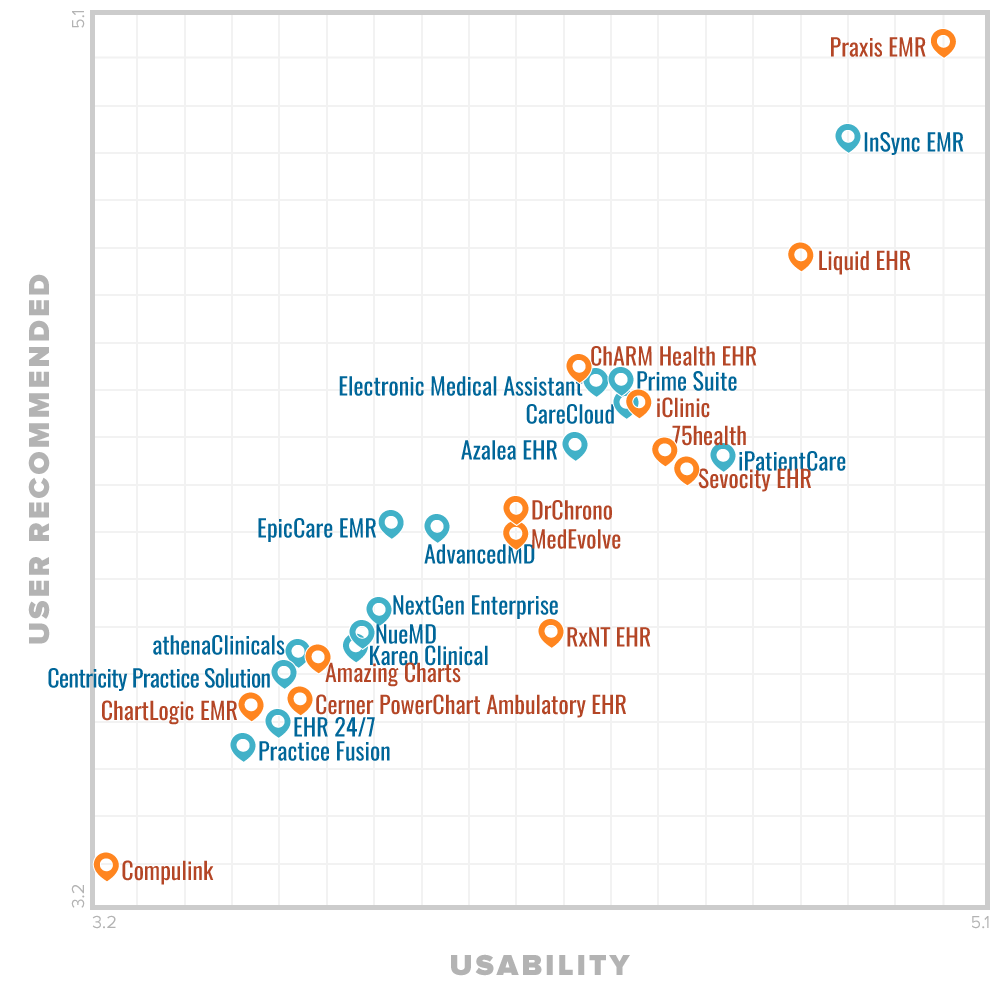
Products Scored Based on User Reviews
Software products were scored in two areas-Usability and User Recommended-based on actual user ratings. EHRs have to offer a core set of functionality-for example, they must be able to create and store digital patient records, generate E/M codes, provide decision support, retain ONC-ATCB certification (meaning the system meets standards set by government health officials) and more. From there, user reviews dictate the Usability and User Recommended scores.
Comparisons
Quick Comparison: Best EHR Software for Small & Private Practices
The best EHR depends on the physician, specialty, practice size, workflow, and business model.
The following systems are among the major EHR and EMR software products that small and private medical practices may want to consider in 2026.
| Rank | EHR / EMR | Best For | Primary Strength |
|---|---|---|---|
| 1 | Praxis EMR | Small, private & independent practices | AI-driven, template-free EHR |
| 2 | Tebra | Independent practices seeking EHR + practice management | Integrated practice and revenue-cycle tools |
| 3 | athenahealth | Practices prioritizing billing and revenue cycle | Large healthcare network and RCM capabilities |
| 4 | DrChrono | Small practices and mobile-first physicians | Flexible cloud and mobile workflow |
| 5 | Elation Health | Primary care and direct primary care | Clinical-first workflow |
| 6 | eClinicalWorks | Growing small and midsize practices | Broad functionality and integrations |
| 7 | AdvancedMD | Multi-specialty private practices | EHR + practice management |
| 8 | NextGen Healthcare | Growing independent groups | Multi-specialty functionality |
| 9 | Practice Fusion | Budget-conscious practices | Cloud-based EHR |
| 10 | RXNT | Small practices seeking transparent pricing | EHR + practice management |
| 11 | CharmHealth | Small and independent practices | Flexible, lower-cost options |
| 12 | SimplePractice | Behavioral health private practices | Practice management and client engagement |
Pricing, features, integrations, and vendor offerings change frequently. Practices should verify current pricing and functionality directly with each vendor before making a purchasing decision.
The Top EHR & EMR Software for Private Practices
Praxis EMR, Tebra, athenahealth, DrChrono, Elation Health, eClinicalWorks, AdvancedMD, NextGen Healthcare, Practice Fusion, RXNT, CharmHealth and SimplePractice












1. Praxis EMR
Praxis is our #1 EHR for small and private practices because it combines a fundamentally different approach to clinical documentation with modern AI capabilities and strong physician satisfaction.
Praxis is not simply a traditional template-based EHR with an AI scribe added to it.
It is an AI-driven, template-free EHR designed to learn from the physician.
Its Concept Processing technology learns from how each physician documents and uses the system.
That makes the software increasingly personalized over time.
Key Praxis Features
- Template-free clinical documentation
- AI-powered Concept Processing
- Reflective Ambient Intelligence™
- Electronic prescribing
- EPCS
- Laboratory integration
- Patient portal and engagement
- Telehealth
- Quality reporting
- Interoperability
- Billing integrations
- Clinical documentation
- Longitudinal patient records
- Physician-specific personalization
Praxis is particularly attractive to physicians who believe an EHR should become easier to use over time rather than forcing the physician to continually adapt to the software.
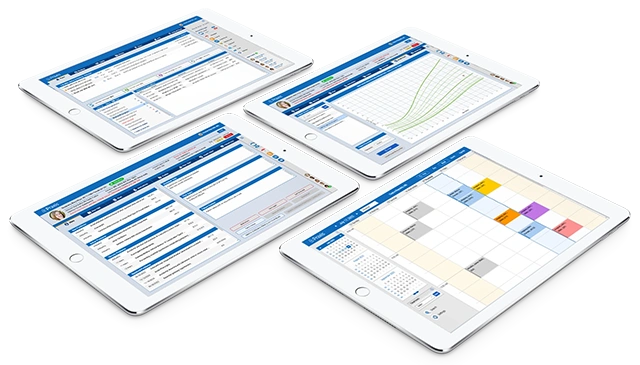
How Praxis EMR Works
Praxis EMR is dramatically different. It thinks like you do. The Artificial Intelligence (AI) inside Praxis gets faster and easier as you use it. Praxis is not just an EHR system; it's a medical tool.

2. Tebra
Tebra, formerly associated with Kareo and PatientPop, focuses heavily on independent medical practices.
Its platform combines EHR capabilities with practice management, billing, patient engagement, and other administrative functions.
Tebra can be particularly attractive to practices that want multiple practice-management functions from one vendor.
Its primary strength is its focus on independent practices and the broader business side of running a medical practice.
Best for: Independent practices that want EHR, practice management, billing, and patient engagement in one ecosystem.





3. athenahealth
athenahealth is one of the largest ambulatory healthcare technology vendors and offers EHR, practice management, patient engagement, and revenue-cycle capabilities.
athenahealth is particularly known for its network-based approach and revenue-cycle infrastructure.
For practices that prioritize billing performance, payer connectivity, and a large healthcare network, athenahealth is an important EHR to evaluate.
The trade-off for a small independent practice can be greater complexity than a physician-centered EHR designed specifically around individual workflow.
Best for: Practices prioritizing revenue cycle, payer connectivity, and a broad ambulatory healthcare platform.

4. DrChrono
DrChrono is a cloud-based EHR and practice-management platform with a strong emphasis on mobility and flexibility.
Its platform includes clinical documentation, patient engagement, scheduling, billing, electronic prescribing, and other ambulatory-care capabilities.
DrChrono can be particularly attractive to physicians who want to use mobile devices as part of their clinical workflow.
Best for: Small practices looking for a flexible, mobile-oriented EHR.

5. Elation Health
Elation Health focuses heavily on primary care and independent physicians.
Its platform emphasizes clinical workflow and longitudinal patient care and has increasingly incorporated AI capabilities into its product.
Elation can be particularly attractive to primary care and direct primary care practices looking for a clinically focused EHR.
Best for: Primary care, independent primary care, and direct primary care.

6. eClinicalWorks
eClinicalWorks is a large ambulatory EHR platform used across many specialties.
The system offers extensive clinical, practice-management, patient-engagement, telehealth, and interoperability capabilities.
Its breadth can be valuable for growing practices, although smaller practices should carefully evaluate implementation, training, and workflow complexity before choosing a large platform.
Best for: Growing practices that need broad multi-specialty functionality.

7. AdvancedMD
AdvancedMD combines EHR and practice-management capabilities and is particularly focused on ambulatory medical practices.
The platform offers clinical documentation, scheduling, billing, patient engagement, reporting, and other practice-management functions.
It can be a strong option for practices that want clinical and administrative functionality from one platform.
Best for: Growing private and multi-specialty practices.

8. NextGen Healthcare
NextGen Healthcare provides EHR, practice-management, interoperability, and patient-engagement solutions for ambulatory practices.
It is particularly relevant to practices that are growing beyond the solo or very small practice stage and need more extensive administrative and clinical capabilities.
Best for: Growing independent and multi-specialty practices.

9. Practice Fusion
Practice Fusion is a cloud-based EHR platform serving ambulatory practices across multiple specialties.
Its cloud model and relatively straightforward approach can make it attractive to practices looking for a more conventional EHR.
Physicians should carefully evaluate current pricing, functionality, support, and contract terms because EHR pricing and product offerings change over time.
Best for: Practices seeking a conventional cloud EHR at a lower price point.

10. RXNT
RXNT provides EHR, practice management, billing, and related healthcare software.
The platform focuses on smaller medical practices and offers a broad set of ambulatory capabilities.
Best for: Small practices seeking EHR and practice-management functionality with a focus on straightforward pricing.

11. CharmHealth
CharmHealth provides EHR and practice-management tools for a variety of healthcare practices.
Its flexible pricing structure can make it attractive to smaller practices and physicians who want to control software costs.
Best for: Small and independent practices seeking flexible pricing and a broad range of capabilities.

12. SimplePractice
SimplePractice is particularly well known in behavioral health and private-practice settings.
Its platform focuses on practice management, scheduling, documentation, billing, telehealth, client communication, and patient engagement.
For physicians in general medical specialties, other EHRs may provide deeper medical functionality. For behavioral health professionals and therapists, however, SimplePractice is an important option to consider.
Best for: Behavioral health and therapy private practices.
Last Updated: September 2026
This guide was updated in September 2026 to reflect the current EHR and EMR software market, artificial intelligence developments, physician usability considerations, independent user reviews, and the evolving needs of small, private, independent, and solo medical practices.
EHR software, pricing, features, integrations, and user ratings can change over time. Practices should verify current information directly with each vendor before making a purchasing decision.
What Features Should a Small or Private Practice Look For?
Before choosing an EHR, physicians should evaluate the following.
Clinical Documentation
Can physicians efficiently document a complete encounter?
Telehealth
Does the system support virtual care?
Patient Records
Can physicians quickly understand the patient's longitudinal history?
Patient Intake
Can patient information and forms be collected electronically?
Medications
Can medication lists, refills, prescribing, and medication history be managed efficiently?
ePrescribing and EPCS
Does the system support the prescribing requirements of the practice?
Billing
Does it integrate with the practice's billing workflow?
Quality Reporting
Does it support applicable quality-reporting requirements?
Laboratory Integration
Can laboratory results flow directly into the patient's chart?
Support
What happens when the practice needs help?
Interoperability
Can the system exchange information with other healthcare organizations?
Security
Does the vendor provide appropriate security, privacy, and compliance capabilities?
Patient Portal
Can patients communicate with the practice securely?
Training
How long does it take physicians and staff to become proficient?
Key Benefits of the Best EHRs
The highest quality EHRs will of course have much more of an upside compared to any average EHR. Here are some of the benefits of the top EHR systems:
Easy to Use
The best EHRs are easy to use, helping doctors work manageably with intuitive and flexible programs.
Secure
The best EHRs are HIPAA compliant and encrypted, protecting a practice's information, both for the practice itself and the patient.
AI-Driven
The best EHR should have an AI system that learns and adapts based on a doctor's practice preferences and gets faster and smarter as it is used.
Fast
An EHR system enables doctors to work both easier and faster; efficiency is a trait that is pertinent for any business and is vital to the best EHRs.
Affordable
The best EHRs are affordable and offer the most bang for the buck by saving practitioners money and time and helping them to practice quality medicine efficiently.
Certified
Has the comprehensive security, functionality and interoperability features of an EHR to be certified by the Certification Committee for Health Information Technology (CCHIT) for MACRA attestation.
High-Quality
A high-quality EHR system is made up of a reliable, high performing, and user-friendly program that prompts better quality care from its users.
Interoperable
Being able to share information between different EHR systems and share information between providers.
Award-Winning
Rankings and awards, like the ACP, AAFP, Software Advice FrontRunners guide, will highlight the finest EHRs based on real life user experience.
Legal Protection
The best EHR will assure its users are abiding with HIPAA requirements, documentation guidelines, and many other legal needs to protect its doctors and ensure quality care.
Customer Satisfaction
Only the best EHR can be rated #1 in customer satisfaction and usability from physician-users who enjoy improved efficiency and medical quality, with increased revenues and professional satisfaction.
Template-Free
Only a template-free EHR will allow more freedom for the doctor as the software is comprehensively customized around the physician rather than relying on cumbersome and uncompromising templates.
Choosing the Best EHR for Small Practices in 2026
EHR vs. EMR: What's the Difference?
EHR and EMR are often used interchangeably, although there is a technical distinction.
Electronic Medical Record (EMR)
An EMR (Electronic Medical Record) generally refers to a digital medical record maintained within a particular practice.
Electronic Health Record (EHR)
An EHR (Electronic Health Record) is broader and is designed to support the sharing of patient information across healthcare providers and organizations.
In everyday healthcare technology searches, however, physicians frequently use the terms interchangeably.
That means someone searching for:
Best electronic medical records software may be looking for essentially the same type of technology.
This guide covers both EHR and EMR software.
Still using a Template EHR System?
Switch to Praxis EMR and start saving 2-3 hours a day.